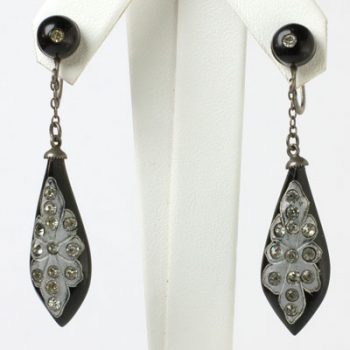
Black Bakelite & Diamanté Art Deco Dangle Earrings
Art Deco emerged as a dazzling symbol of the glamour, innovation, and luxury of the 1920s and reached its height between the two World Wars. Defined by bold geometric forms, rich colors, and stylized motifs inspired by exotic cultures and modern industry, the movement transformed nearly every aspect of design—from architecture and decorative arts to film, photography, fashion, and, naturally, jewelry.
Although the style flourished during the 1920s and 1930s, the term Art Deco was not coined until the 1960s. It takes its name from the Exposition Internationale des Arts Décoratifs et Industriels Modernes, a landmark design exhibition held in Paris in 1925. Originally planned for 1914 but delayed by World War I, the fair introduced the world to a sleek, modern aesthetic that would come to define an era.
Because style reflects the social, cultural, and historical forces of its time, it is worth exploring the influences that shaped Art Deco—and how they transformed fashion and jewelry during the 1920s.
Art Deco Jewelry Influences
By the early 20th century, artists and designers began turning away from the flowing, asymmetrical lines and muted palette of Art Nouveau. Characterized by intricate organic forms inspired by flowers, insects, and idealized female figures, Art Nouveau celebrated nature and elegance. Iconic examples of the style include Tiffany stained glass, the posters of Alphonse Mucha, and even the graceful ironwork of the Eiffel Tower.
At the same time, bold new artistic movements were emerging across Europe. Among the most influential was Cubism, pioneered by Pablo Picasso and Georges Braque. In 1907, Picasso shocked the art world with Les Demoiselles d’Avignon, a portrait of five women that rejected traditional perspective in favor of flattened, fragmented forms. Two of the figures featured mask-like faces inspired by African art, signaling a dramatic break from artistic convention.
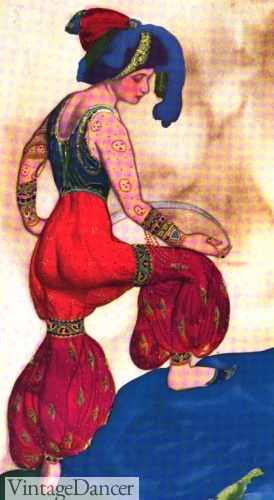
Beginning in 1909, designer Léon Bakst introduced avant-garde aesthetics infused with Orientalist and so-called “primitive” influences through his vivid stage sets and costumes for the Ballets Russes. His dazzling use of saturated color and elaborate patterning captivated audiences, especially in Sergei Diaghilev’s 1910 production of Schéhérazade, which became a sensation in Paris.
The bold palettes and lavish designs stood in striking contrast to the soft, pale, lace-filled fashions of the Edwardian era. Soon, le style Ballets Russes ignited the imagination of Parisian couturiers and interior designers, inspiring dramatic new approaches to fashion and décor. Bakst’s influence spread internationally, including through illustrated programs promoting the Russian Ballet’s American tours in the 1910s.
Interest in exotic design only intensified with Howard Carter’s discovery of King Tutankhamun’s tomb in 1922. The event sparked a cultural obsession known as Egyptomania, bringing Egyptian motifs—scarabs, lotus flowers, pyramids, and pharaoh imagery—into fashion, interiors, and the decorative arts. Rich jewel tones such as turquoise and lapis blue became especially popular, leaving a lasting imprint on Art Deco design. Jewelry, in particular, embraced these influences with striking geometric interpretations of ancient forms.
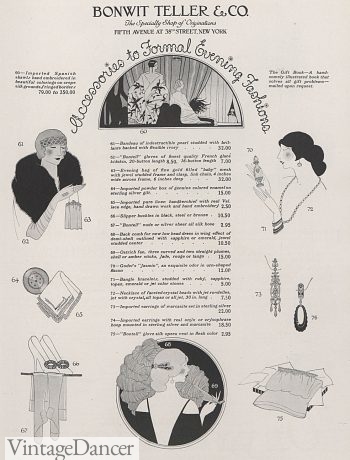
1923 Art Deco accessories
1920s Fashion: The Flapper
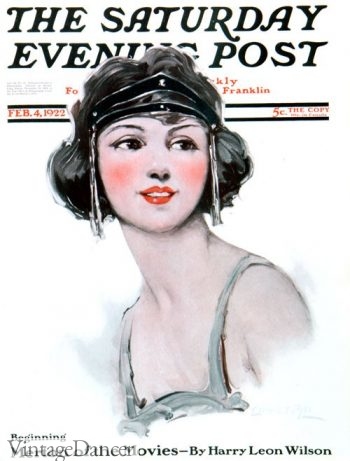
1922 Saturday Evening Post: The Flapper
Although La Garçonne—the defining fashion silhouette of the 1920s—first appeared in 1922, it did not become truly widespread until the middle of the decade. The term came from Victor Margueritte’s controversial 1922 French novel La Garçonne, meaning The Bachelor Girl or, more familiarly, The Flapper. The image of this modern woman quickly became a cultural icon, as illustrated in period artwork such as the cover of the Saturday Evening Post from February 4, 1922.
The garçonne silhouette embraced a tubular, almost androgynous shape that rejected the curves of earlier fashions. Dresses featured vivid colors, bold geometric or exotic patterns, and dropped—or entirely absent—waistlines. Hemlines rose dramatically during the decade, climbing from ankle-length in 1924 to knee-length by 1925, where they largely remained through the end of the 1920s.
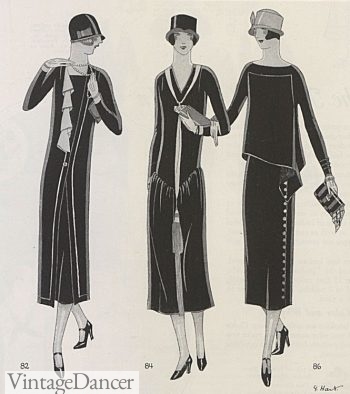
1924 Vogue fashion – daytime dresses
Fashion emphasized a slim, youthful figure with square shoulders, a flattened bust, narrow hips, and elongated legs. For women whose natural shape did not fit the ideal, foundation garments helped create the fashionable silhouette. A 1923 Vogue advertisement cleverly observed: “Being slim may be a matter of pounds, but looking slim is a matter of where those pounds are placed.” Gossard corsets and brassieres promised an effortless way to preserve a youthful appearance.
The flapper came to symbolize the independence and spirited energy of the Jazz Age. Her cropped hairstyle inspired a new accessory perfectly suited to the modern look: the French cloche hat. Fitted closely to the head and gently framing the face, the cloche featured brims that either turned upward or dipped low over the eyes, lending an air of mystery and sophistication to the fashionable woman of the 1920s.
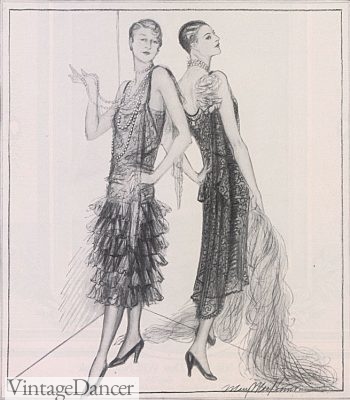
1925 Vogue Flapper Fashion
Read more: The Flapper, who was she? History of Flappers in the 1920s
Shop Art Deco dresses and evening gowns in the 20s and 30s style.
The Flapper’s Art Deco Jewelry
In earlier decades, most women—except the very wealthy—owned only a few treasured pieces of jewelry, such as a strand of pearls or a cherished brooch, reserved for special occasions. By the 1920s, however, attitudes toward jewelry had changed dramatically. Women across nearly every income level began selecting jeweled accessories to complement individual outfits, much as they chose shoes, handbags, and hats.
Costume jewelry emerged as an essential element of fashionable dress, no longer viewed as a mere imitation of fine jewelry but as a stylish accessory in its own right. Affordable, versatile, and endlessly adaptable to changing trends, it allowed women to embrace fashion in new and expressive ways.
A 1922 article in Women’s Wear Daily observed this growing phenomenon:
“More and more importance is being given to costume jewelry each day, and department stores and avenue shops feature it in their windows and store cases in a lavish manner. These small articles that are depended on so very much of late for dress decoration are now considered important enough to be given entire windows for their display, and with the advent of the latest novelties from Paris, the avenue shops especially have been featuring all this class of merchandise.”
The article highlights how costume jewelry had become a fashionable necessity of the Jazz Age, celebrated not only for its decorative appeal but also for its ability to keep pace with the rapidly evolving styles of the decade.
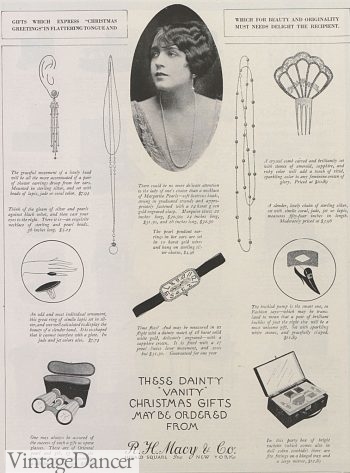
1922 Art Deco earrings, necklace, watch, hair clip
White metals—including pot metal, silver, nickel, chrome, and brass—formed the foundation of much 1920s jewelry design. Clear crystal stones and beads, often used to imitate rock crystal, appeared alongside richly colored glass gems designed to resemble precious stones such as emeralds, rubies, and sapphires. Shimmering materials like paste stones and marcasites added sparkle, either standing alone or serving as accents that heightened contrast and brilliance.
The introduction of early plastics—including Bakelite, Galalith, and Celluloid—opened exciting new possibilities for jewelry designers. These innovative materials allowed creators to move beyond imitations of fine jewelry, experimenting instead with bold modern forms, striking color combinations, and an almost limitless palette unavailable in traditional gemstones.
As fashion embraced the elongated silhouette of the mid-1920s and social dancing became a defining pastime of the Jazz Age, jewelry evolved to complement movement and drama. Dazzling Art Deco pieces were designed to sway, shimmer, and catch the light, drawing attention to the wearer with every step and turn across the dance floor.
Long strands of beads and faux pearls became especially fashionable. They were worn traditionally around the neck, draped sensuously down the back of evening gowns, looped across bare shoulders, or wrapped repeatedly around the wrist to resemble stacked bracelets. Other popular necklace styles included chokers, lariats, sautoirs—long strands of beads or pearls ending in tassels—and dramatic fringe necklaces. The examples shown here, all dating from the 1920s, reflect the glamour, movement, and modern spirit that defined Art Deco jewelry.
-
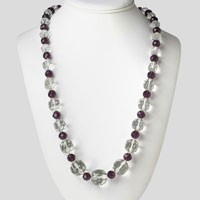
- Amethyst & Crystal Bead 35” Long Necklace
-
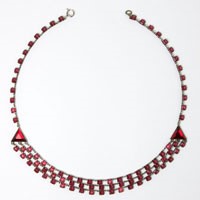
- Ruby Chicklet Festoon Necklace
-
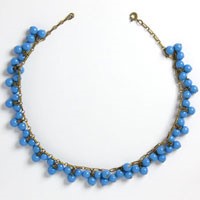
- Blue Bead Fringe Necklace
With shorter hair in style, women’s ears required adornment. A September 15, 1921 Vogue article reported: “Pendant earrings are returning to fashion … Frenchwomen and Englishwomen have both adopted, or rather re-adopted, these ornaments”. Here are some examples of 1920s Art Deco earrings.
-
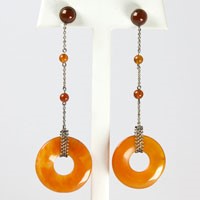
- Carnelian Ring & Sterling German Earrings
-
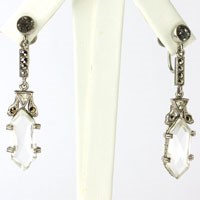
- Crystal & Marcasite Dangling Czech Earrings
-
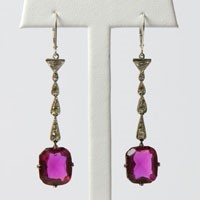
- Ruby, Diamanté & Sterling Earrings
Another type of essential 1920s jewel was the brooch, which decorated cloche hats and jacket lapels. Brooches were also worn on shoulders, applied to belts, and placed at the hip. Here are some examples of Art Deco brooches made in the 1920s.
-
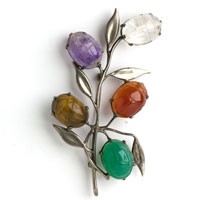
- Scarab & Sterling Brooch by Walter Lampl
-
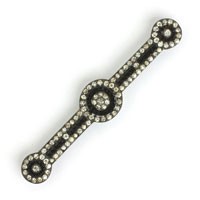
- Onyx, Diamanté & Sterling Bar Brooch by Fishel, Nessler
-
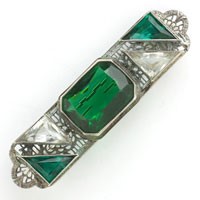
- Emerald, Crystal & Filigree Brooch by Ostby & Barton
-
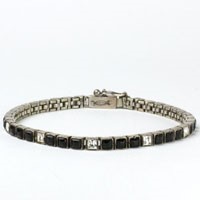
- Onyx, Diamanté & Sterling Line Bracelet by Fishel, Nessler
-
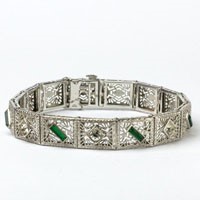
- Emerald, Diamanté & Sterling Filigree Bracelet
-
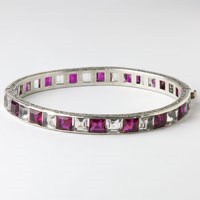
- Ruby, Crystal & Sterling Bangle by H. Payton
The End of the Roar
The flapper, luxury, and good times that characterized the Roaring ‘20s came to a sudden end on October 29, 1929, when the stock market crashed in the U.S. It launched the Great Depression that spread around the world. But that’s another story.
The glamour, prosperity, and carefree spirit that defined the Roaring Twenties—and embodied the image of the flapper—came to an abrupt halt on October 29, 1929, when the U.S. stock market crashed. The event triggered the Great Depression, an economic crisis that soon spread across the globe, reshaping fashion, culture, and daily life in profound ways.
The exuberance of the Jazz Age faded, but the influence of the 1920s endured—especially in the bold designs and enduring elegance of Art Deco jewelry. What followed, however, is another story.
Debbie Sessions has been teaching fashion history and helping people dress for vintage themed events since 2009. She has turned a hobby into VintageDancer.com with hundreds of well researched articles and hand picked links to vintage inspired clothing online. She aims to make dressing accurately (or not) an affordable option for all. Oh, and she dances too.